Diverse by design
Combine conventional contact PPG with remote PPG reconstructed from video and data from multiple devices and populations.
ARIS postdoctoral project · 2026–2028
LANTERN-PPG is developing a general-purpose, explainable AI foundation model for photoplethysmography—the optical pulse signal captured by wearables, pulse oximeters, and cameras.
The research challenge
PPG makes continuous cardiovascular and psychophysiological monitoring accessible, but models trained for a single dataset or task often struggle across people, sensors, and real-world conditions. LANTERN-PPG aims to replace isolated models with a reusable, transparent backbone.
Combine conventional contact PPG with remote PPG reconstructed from video and data from multiple devices and populations.
Use self-supervised learning to capture waveform morphology and physiological structure from large, mostly unlabelled collections.
Connect model decisions to meaningful parts of the pulse wave through attention, gradient, and reconstruction-based explanations.
System architecture
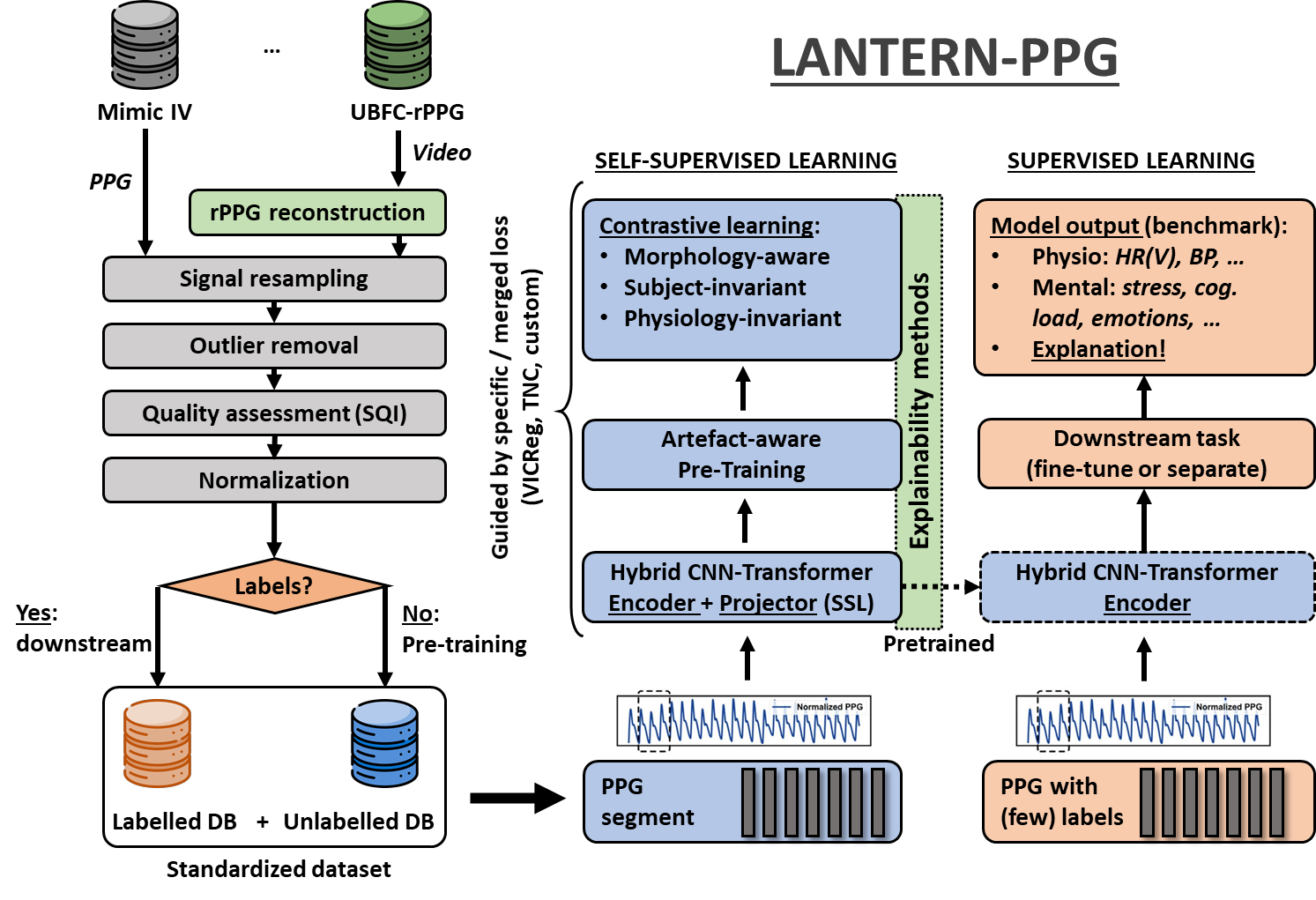
The pipeline standardizes and quality-indexes diverse PPG sources, pre-trains a hybrid CNN–Transformer with complementary self-supervised objectives, and adapts the learned encoder to downstream tasks with explanation methods integrated throughout.
Research programme
Each stage produces the foundation for the next, while explainability and dissemination connect the technical work to scientific and practical use.
Months 1–5
Months 6–18
Months 12–18
Months 18–24
Throughout
Expected outcomes
The project will assess whether a shared PPG backbone can generalize across sensors, populations, and tasks while requiring fewer labels and offering explanations aligned with meaningful waveform characteristics.
Potential downstream tasks
Reusable research
A curated, quality-aware data resource and a standard suite of tasks for comparable evaluation, where licensing and ethics permit.
Transparent AI
A hybrid foundation encoder paired with interpretable maps that show which waveform regions contribute to its representations and predictions.
Project details
LANTERN-PPG is an ARIS-funded postdoctoral research project hosted by the Department of Intelligent Systems at the Jožef Stefan Institute in Ljubljana, Slovenia.
Project documents
Project governance and communication documents are available below as downloadable PDFs.